
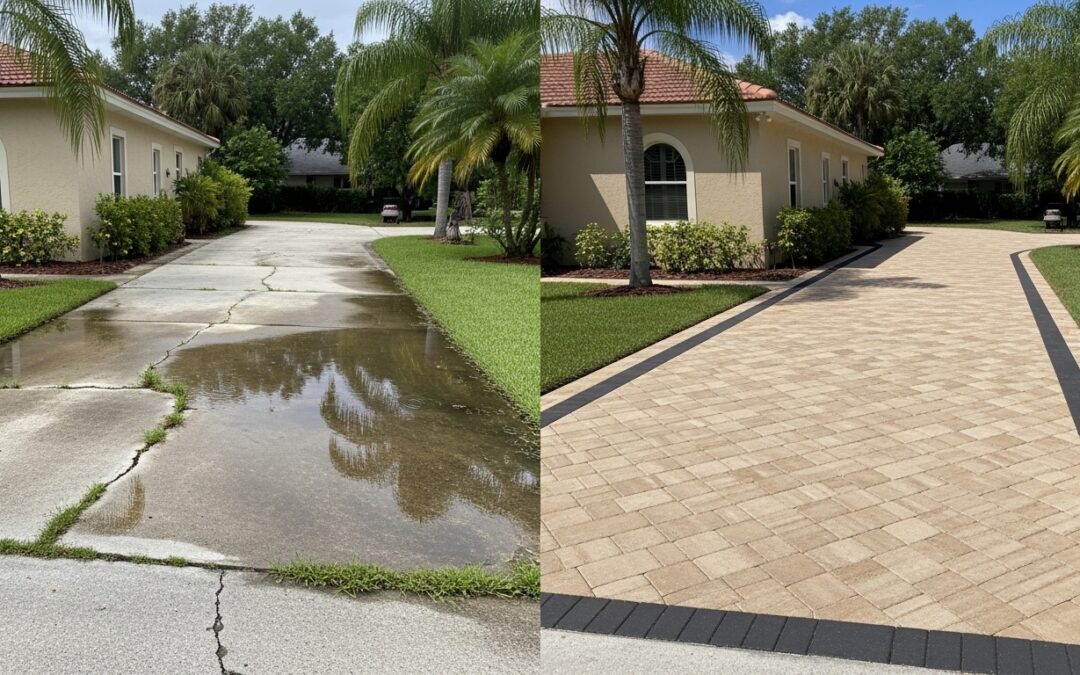
When you are planning a driveway renovation in the Tampa Bay area, the debate inevitably comes down to two heavyweights: Pavers vs Concrete Driveway. It seems like a simple choice between aesthetics and budget, but in Florida, it is actually a complex question of engineering and environmental survival. Most homeowners look at the upfront price tag and lean toward poured concrete. It’s a solid slab, it’s cheaper initially, and it gets the job done until the Florida climate goes to work on it. If you are trying to decide between a flexible paver system and a rigid concrete slab, you need to understand exactly how our unique environment attacks your hardscape.
At Outdoor Living Pros, we have replaced hundreds of cracked concrete driveways from South Tampa to Wesley Chapel. The story from homeowners is always the same: “It looked great for two years, and then the hairline cracks started.” This comprehensive guide breaks down the Pavers vs Concrete Driveway comparison by the numbers, focusing heavily on durability, drainage, soil science, and long-term property value in the Tampa Bay climate.
The Core Problem: Why Concrete Fails in Tampa Soil
To understand why concrete fails here, you have to look underground. Tampa and St. Petersburg sit on top of highly variable soil compositions, primarily “Sugar Sand” (Myakka fine sand), limestone, and scattered clay deposits. This soil is highly permeable in some areas and completely water-logged in others. More importantly, it is incredibly prone to shifting.
When it rains—and Tampa averages over 50 inches of rain a year the water table rises, effectively pushing up against your driveway from below via hydrostatic pressure. When the dry season hits, the soil contracts, dries out, and sinks.
The “Rigid Slab” Failure Mode
A poured concrete driveway is a rigid monolith. It has absolutely zero flexibility. When the sandy soil beneath it shifts, sinks, washes out, or expands, the concrete cannot bend to accommodate the new shape of the earth. It bridges the gap for a while, but eventually, the tension becomes too high, the structural integrity is compromised, and the slab snaps.
Once a concrete driveway cracks, you are left with two highly unappealing options:
- Patch it: This leaves an ugly, highly visible scar that never matches the original weathered color of the concrete.
- Replace it: You have to bring in heavy machinery to jackhammer the entire damaged section out and repour it, hoping the new batch cures correctly.
The Paver Advantage: Flexible Engineering
Interlocking pavers are designed specifically to handle this constant shifting. A driveway paver installation is not a solid sheet; it is engineered as a “flexible pavement system.” It consists of thousands of individual high-strength concrete or natural stone units locked together with joint sand.
When the ground underneath a paver driveway shifts due to Tampa’s heavy rains or dry spells, the individual pavers move slightly with the earth. They “flex” rather than break. This is the exact reason why you see ancient Roman roads made of individual stones that are still intact after 2,000 years, while modern concrete roads frequently crack in less than 20 years. In the Pavers vs Concrete Driveway durability battle, flexibility always wins in sandy, unstable soil.
Pavers vs Concrete Driveway: The True Cost Breakdown
Let’s address the elephant in the room that every homeowner in Florida asks about: Cost. If you are strictly looking at the Year 1 price tag, concrete is the winner. However, a driveway is a multi-decade investment. If you look at the “Total Cost of Ownership” over a 15 to 30-year lifespan, the math changes significantly in favor of pavers.
1. Upfront Installation Cost
- Poured Concrete: Typically, standard concrete is highly labor-efficient because a cement truck pours it, and the crew smooths it out in a single day. The materials are relatively cheap, making the initial barrier to entry low.
- Paver Driveway: The initial cost is higher. This is due to the intense labor involved (properly grading the soil, compacting the aggregate base, and hand-laying the stones) and the manufacturing cost of the high-density pavers themselves.
2. Repair and Maintenance Costs Over Time
This is where the Pavers vs Concrete Driveway financial comparison completely flips.
- Concrete Repair: In Florida, it is common for aggressive oak tree roots to lift a section of your driveway. With concrete, you have to cut out a massive square, chop the root, and repour the slab. The new concrete will be a bright white/grey, while your old concrete is sun-faded. It will look like a patchwork quilt forever. Furthermore, concrete naturally degrades over time, requiring expensive resurfacing.
- Paver Repair: If a tree root lifts a section of pavers, the repair is brilliantly simple. We simply “unzip” that specific section by removing a few stones, cut the intruding root, re-level the crushed aggregate base, and put the exact same pavers back in place. The material cost is zero. The labor is minimal. Best of all, there is no ugly patch because the stones are the original, perfectly color-matched units.
Pro Tip: In the Tampa market, stamped concrete is frequently sold by contractors as a “cheaper, just-as-good alternative” to pavers. Be warned: Stamped concrete is still just a rigid concrete slab. It will still crack due to soil shifting, and when it does, the crack often runs right through the fake stamped “grout lines,” ruining the expensive illusion immediately and permanently.
Drainage: The Hidden Factor in Florida Hardscaping
Tampa’s afternoon summer thunderstorms are legendary. A standard two-car concrete driveway is effectively a massive 400-square-foot dam. When two inches of rain falls in a single hour, that massive volume of water has nowhere to go but into the street (overloading city storm drains), into your landscaping (drowning your plants), or worse, toward your garage and home foundation.
The Permeability Factor
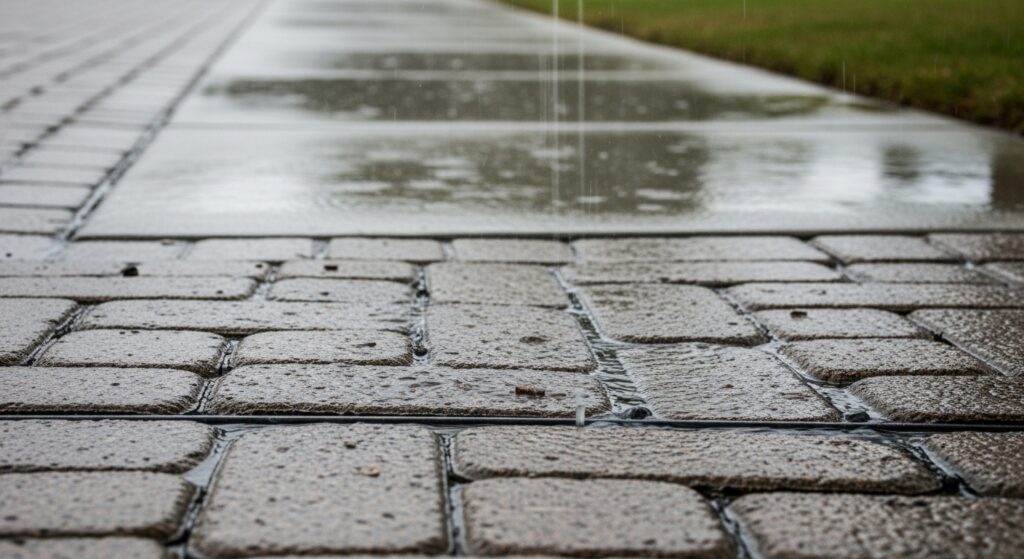
- Concrete: Standard concrete is completely non-permeable. It sheds water rapidly, creating dangerous puddles, slick surfaces, and severe runoff issues. In many Tampa and Clearwater neighborhoods with strict Impervious Surface Ratio (ISR) limits, adding a large concrete driveway or expanding an existing one might not even be legally permitted by the city.
- Pavers: Standard pavers have sand joints that naturally allow for some water percolation back into the earth. However, for maximum efficiency, professional paving contractors can install specific Permeable Paver systems. These utilize a specialized, larger aggregate joint material and an open-graded base that allows massive amounts of water to drain straight through the driveway instantly.
When evaluating Pavers vs Concrete Driveway for flood-prone Florida coastal areas like Shore Acres, South Tampa, or Madeira Beach, pavers are frequently the only code-compliant and logical option to prevent property flooding.
Aesthetics, Curb Appeal, and Property Value
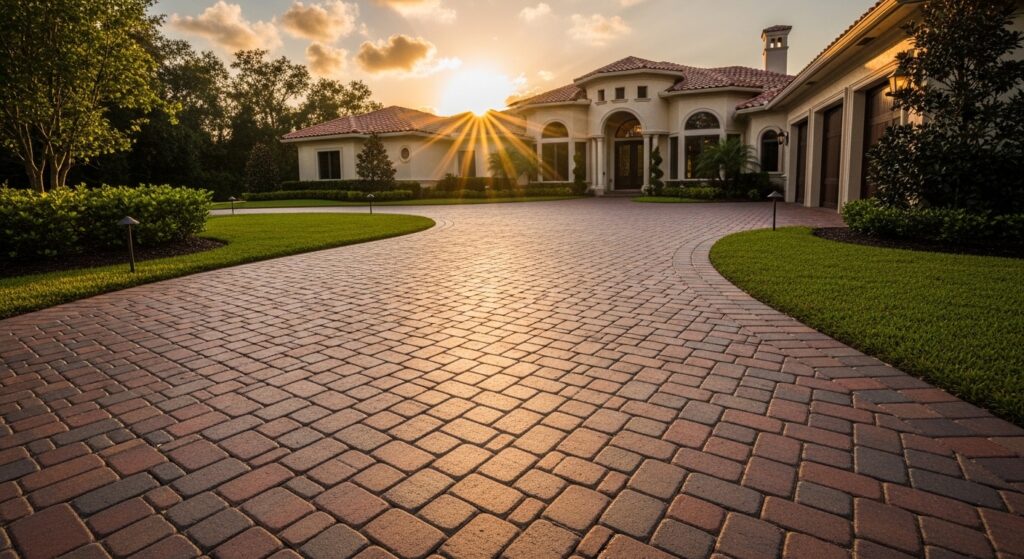
Your driveway is the “red carpet” to your home. It creates the very first impression for guests, neighbors, and potential buyers. The aesthetic differences in the Pavers vs Concrete Driveway debate are stark.
The Limitations of Concrete Aesthetics
Standard brushed concrete is functional, but it is undeniably industrial and boring. While you can upgrade to stamped or stained concrete to mimic stone or brick, it has a fatal flaw: the texture is shallow. Over time, the friction from vehicle tires wears down the stamped texture. Furthermore, the coloring (which is often just a thin surface hardener or topical stain) fades rapidly under the intense UV index of the Florida sun, leaving a washed-out, unnatural appearance.
The Timeless Elegance of Pavers
Pavers offer true architectural depth, texture, and character. Because the color goes all the way through the stone in high-quality manufactured pavers, they do not fade to a dull white like dyed concrete does.
- Design Flexibility: With a Tampa paver installation, you can mix multiple colors, create striking borders, and install intricate patterns like Herringbone, Ashlar, or Basketweave.
- Property Unification: You can match your driveway perfectly to your pool deck or backyard patio, creating a unified, high-end estate look that drastically increases your home’s resale value. Real estate agents consistently note that paver driveways yield a significantly higher return on investment (ROI) than standard concrete slabs.
Heat Absorption and Thermal Mass: The Florida “Barefoot Test”
If you have kids playing basketball in the driveway, or if you regularly wash your car on weekends, the surface temperature of your hardscape matters immensely. The Florida sun is unforgiving, and different materials react to UV radiation and thermal loading in very different ways.
Dark asphalt is notoriously the hottest material, often softening under the brutal August sun. Standard white concrete is slightly cooler to the touch, but it acts as a massive thermal reflector, creating a blinding, uncomfortable glare in the midday sun. Furthermore, concrete has a high “thermal mass.” It absorbs heat all day and slowly radiates it back out at night, which can actually increase the ambient temperature around your home and garage.
Pavers offer a vastly superior middle ground. Earth-tone pavers (tans, creams, light greys, and terracotta) reflect sunlight without the harsh, blinding glare of white concrete. More importantly, because a paver driveway is made of separate units rather than a single massive slab, it does not hold thermal mass in the same way. The sand joints between every single stone allow the earth underneath to “breathe.” This air circulation helps dissipate heat much faster. When comparing a pavers vs concrete driveway for barefoot comfort—especially near pool decks or shaded garage entrances—pavers are consistently more comfortable and manage ambient heat far better.
Compressive Strength Comparison: The Science of Heavy Lifting
For homeowners who own large SUVs, boats, or recreational vehicles (RVs), the load-bearing capacity of a driveway is not just a talking point it is a structural necessity. The strength of paving materials is measured in PSI (Pounds per Square Inch). This metric determines how much weight a surface can take before the material structurally fails.
Let’s look at the engineering data:
- Poured Concrete: A standard residential concrete driveway is poured to achieve a compressive strength of roughly 2,500 to 3,000 PSI. While this is adequate for a standard sedan, the rigid slab distribution means that heavy, concentrated loads (like the tongue jack of a boat trailer or the dual-tires of an RV) can create stress fractures.
- Interlocking Concrete Pavers: High-density concrete pavers are manufactured under extreme pressure in a controlled factory environment. By industry standards (ASTM C936), solid interlocking concrete paving units must have a minimum average compressive strength of 8,000 PSI. Many premium pavers even exceed 10,000 PSI.
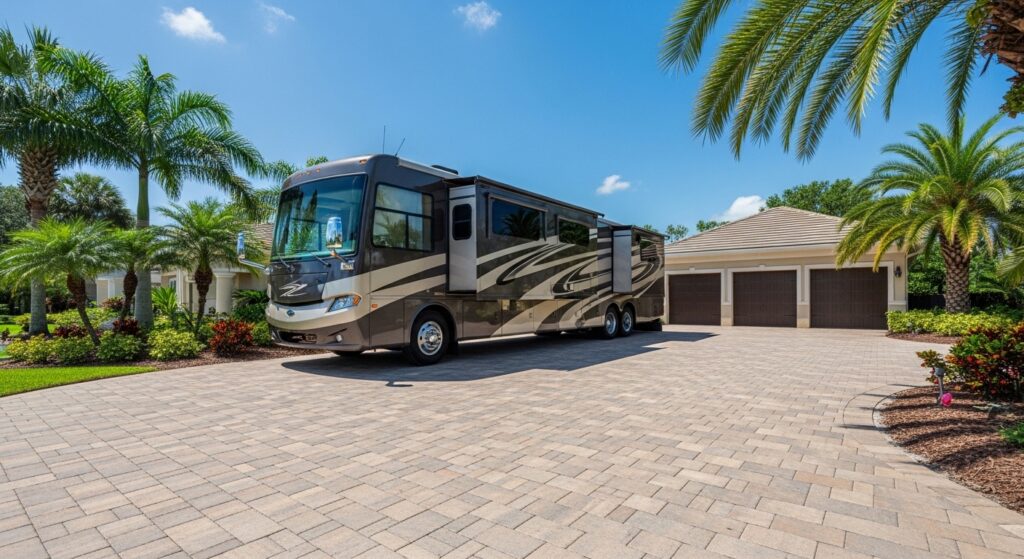
This means that a paver is effectively three to four times stronger than the concrete slab poured by a standard contractor. When a heavy delivery truck pulls onto a paver driveway, the weight is distributed not just downward, but laterally. The interlocking sand joints transfer the kinetic load across multiple stones, absorbing the shock and preventing the surface from cracking. If you plan on parking heavy toys on your property, the pavers vs concrete driveway debate ends instantly: pavers are engineered to take the punishment.
Installation Timelines: The Curing Process vs. Immediate Use
How long will your driveway be out of commission? For many busy Tampa families, losing access to their garage and parking space is a major logistical headache.
The Concrete Cure Cycle: Pouring a concrete driveway is fast—usually completed in a single day. However, the curing time is the hidden inconvenience. Concrete does not “dry”; it cures through a chemical process called hydration. You generally cannot drive a vehicle on new residential concrete for at least 7 to 10 days, and it takes a full 28 days to reach its maximum structural strength. If a delivery driver accidentally turns around in your driveway on day three, your brand-new slab could suffer deep structural fractures before you even get to use it.
The Paver “Instant Load” Advantage: The installation of a paver driveway takes longer on the front end (typically 3 to 5 days depending on the square footage and base excavation). The crew has to meticulously compact the aggregate sub-base, screed the bedding sand, and hand-lay the pattern. However, the moment the crew runs the vibratory plate compactor over the final swept sand joint, the driveway is 100% complete. There is absolutely zero curing time. You can immediately park your cars, drive your truck on it, and resume your normal life.
Maintenance and Longevity in a Tropical Climate
Every exterior surface in Florida requires maintenance to fight off mold, mildew, and weed growth.
- Concrete Maintenance: Concrete is highly porous. If your car leaks oil, or if wet oak leaves sit on the surface for too long, the concrete acts like a sponge, drawing the stain deep into the slab. Removing an oil stain from concrete is notoriously difficult, often requiring harsh muriatic acid that damages the surface finish.
- Paver Maintenance: Because pavers are manufactured to be incredibly dense (to achieve that 8,000+ PSI), their absorption rate is usually less than 5%. They resist stains significantly better than poured concrete. If an oil spill is too severe to power wash away, the modular nature of pavers saves the day again: you simply extract the three or four stained stones and replace them with spares.
A Note on Weeds: Homeowners often worry about weeds growing in the joints of a paver driveway. This is easily preventable. Modern paver installations utilize Polymeric Sand—a high-tech jointing sand activated by water that hardens like concrete. It permanently locks the pavers together, prevents wash-out during heavy Tampa rains, and creates a hostile barrier that stops weed seeds from taking root.
Environmental Impact and Sustainability
As Florida municipalities become more focused on water conservation and runoff management, the environmental impact of your hardscape is an increasingly important factor.
The cement industry is responsible for a massive percentage of global carbon emissions. When a concrete driveway fails and is jackhammered up, those massive chunks of debris end up sitting in local landfills.
Pavers offer a highly sustainable alternative. Because they are individual units, they have a lifespan that can exceed 50 years. If you decide to redesign your landscaping or need to excavate under the driveway to repair a collapsed sewer line, pavers can be picked up, stacked, and reused. There is zero waste. Furthermore, choosing permeable pavers allows rainwater to recharge the local aquifer rather than flooding the city’s overwhelmed stormwater infrastructure.
Frequently Asked Questions (FAQ) About Tampa Driveways
To help clarify the final details of your decision, here are the most common questions our team fields regarding hardscape replacements.
Are pavers cheaper than concrete in the long run? Yes. While the upfront installation cost of a paver driveway is higher (due to labor and base preparation), the total cost of ownership over 20 years is lower. You avoid the expensive cost of tearing out and replacing cracked concrete slabs, and you significantly boost your home’s resale value.
Can I drive a heavy RV on a paver driveway? Absolutely. Because interlocking pavers possess a compressive strength of over 8,000 PSI, they are actually the preferred material for heavy-duty applications. Commercial ports and industrial yards frequently use interlocking concrete pavers precisely because they can handle massive machinery without cracking.
Will the color of my pavers fade in the sun? High-quality pavers are “color-through,” meaning the pigment is mixed throughout the entire concrete block during the manufacturing process. While all materials will experience slight weathering under the intense Florida UV index, pavers will never chip or peel to reveal a plain grey interior, unlike stamped or top-stained concrete.
How long does a concrete driveway last in Florida? If poured perfectly with a solid base, a concrete driveway can last 20 to 30 years. However, in sandy, shifting coastal soils like those found in Pinellas and Hillsborough counties, most concrete driveways begin to show visible, permanent stress cracks within the first 3 to 5 years.
The Final Verdict: Which is Right for Your Tampa Home?
When we weigh the pavers vs concrete driveway debate for the Tampa Bay market, the winner depends heavily on your long-term goals for the property.
Choose Poured Concrete If:
- Your primary constraint is an immediate, strict budget and you cannot stretch the upfront capital for pavers.
- You are “flipping” a house and do not plan on living in the home or retaining the property for more than a few years.
- You do not mind the inevitable, unpredictable cracking that comes with rigid slabs on top of shifting Florida sand.
Choose Interlocking Pavers If:
- You want a structural driveway that adds massive curb appeal and significantly increases your home’s resale ROI.
- You want a “lifetime” engineering solution that can be easily and invisibly repaired if tree roots or plumbing issues occur underground.
- You own heavy vehicles, boats, or RVs and need a surface with an 8,000+ PSI weight rating.
- You live in a flood-prone area and require better surface drainage to protect your property.
At Outdoor Living Pros, we believe in building exterior spaces that last. We specialize in interlocking paver systems because they are scientifically proven to work with the volatile Florida environment, not against it.
Next Steps for Your Driveway Transformation
If you are tired of staring at a cracked, sinking, or stained concrete driveway, it is time to upgrade to a system engineered for the Sunshine State.
Our team is ready to help you design a stunning, high-performance entrance to your home. We will assess your soil conditions, check your property’s drainage flow, and show you a portfolio of paver styles that will transform your curb appeal instantly.
Ready to see the difference for yourself? Visit our Quotes page today to schedule your free, no-obligation design consultation and site evaluation!
Recent Comments